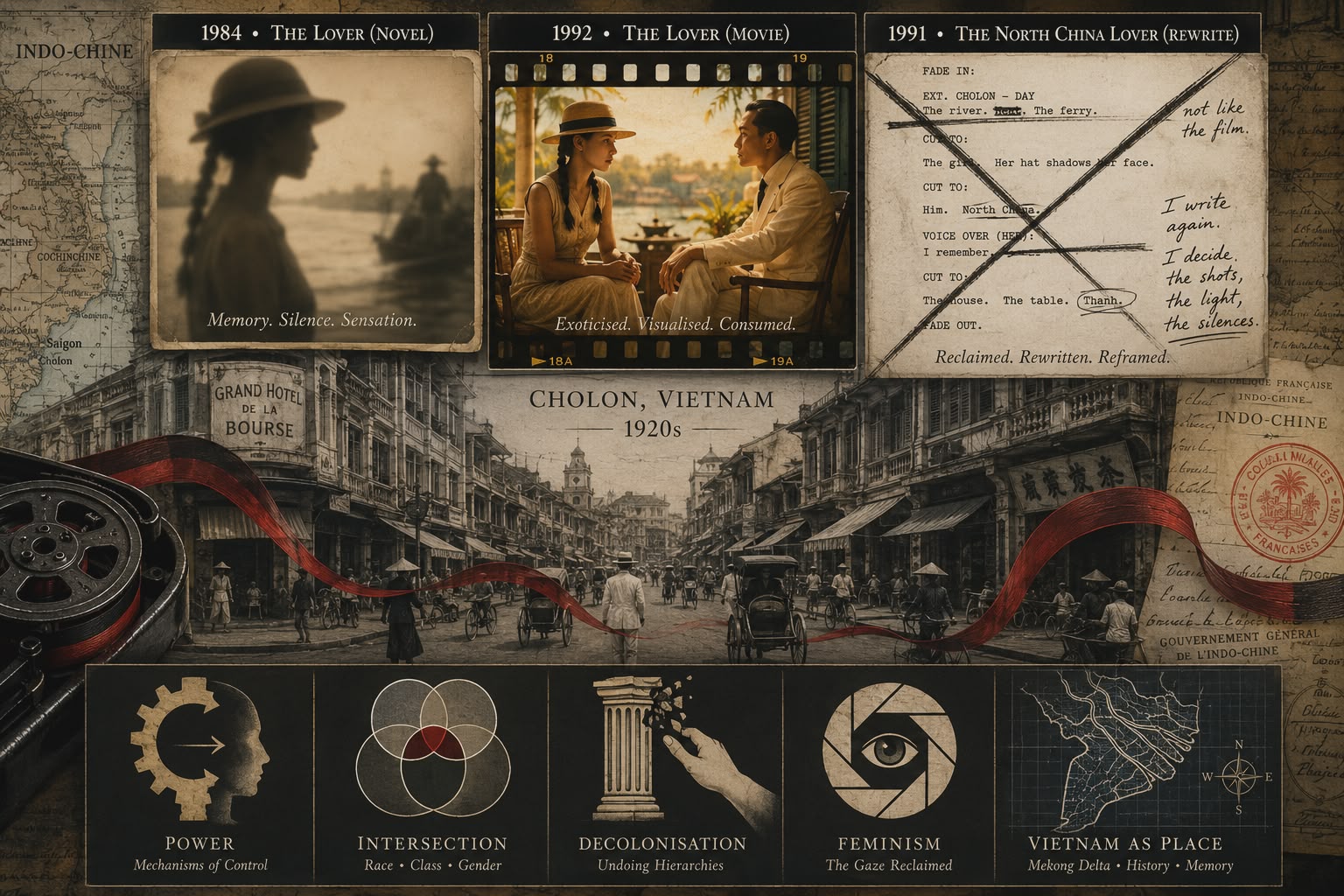

Marguerite Duras’s 1984 novel The Lover, its 1992 cinematic adaptation by Jean-Jacques Annaud, and her 1991 retaliatory rewrite The North China Lover collectively provide an exceptional entry point into postfoundational studies. By examining the metamorphosis of this singular narrative across three iterations, we are introduced to a framework of core postfoundational concepts: the anti-essentialist nature of identity and memory, the Foucauldian dynamic of discourse as a mechanism of power, and the radical contingency of social hierarchies. Crucially, these theoretical abstractions are not ungrounded; early twentieth-century Vietnam serves as the specific historical and geographical locus through which all of these concepts are revealed. The overlapping vectors of feminism, decolonization, postcolonization, and intersectional power do not exist in a vacuum—they are produced by and manifested within the material, socio-political realities of French-occupied Indochina. When we trace the evolution of this story across its three distinct versions, we witness a live demonstration of how reality is constructed rather than discovered. Traditional literary analysis often searches for a foundational truth hidden behind a work of fiction, operating on the assumption that there is a definitive, objective reality that the author is trying to represent. A postfoundational approach explicitly rejects this premise, arguing instead that no bedrock original reality exists to be found. Every version of a narrative is a curated construction, proving that truth is a process of ongoing negotiation rather than a fixed point in the past. What we accept as true depends entirely on historical context, the power dynamics at play, and the medium being utilized to tell the story. Duras’s personal truth shifted when she wrote as an older woman looking back on her youth, and it fractured completely when subjected to the financial and visual pressures of a major commercial film studio. This literary evolution highlights a core anti-essentialist concept: identity, race, class, and memory are never fixed essences but are instead fluid, highly contingent relationships that constantly shift depending on who is controlling the narrative framework of this specific colonial setting.
"...et soudain elle n'était plus sûre de ne pas l'avoir aimé d'un amour qu'elle n'avait pas vu parce qu'il s'était perdu dans l'histoire comme l'eau dans le sable et qu'elle le retrouvait seulement maintenant à cet instant de la musique jetée à travers la
"...and suddenly she was no longer sure she hadn't loved him with a love she hadn't seen because it had lost itself in the story like water in the sand and she found it only now, at this moment of the music thrown across the sea."
Within the theoretical paradigm of Michel Foucault, sexuality is never considered an untainted realm of pure romance. Foucault posits that sexuality serves as a dense transfer point of power and a primary tool of biopolitics, which institutions use to classify, censor, and manage living bodies. Reading this narrative through such a lens forces the reader to reject sentimental interpretations of a transcendent love story. Instead, the text demands an analysis of the complex intersection of race, gender, age, and economic capital—forces that explicitly defined the stratified society of early twentieth-century colonial Vietnam. The room in Cholon where the intimate encounters between the young white girl and the older Asian man unfold operates as a heterotopia—a separate, enclosed space where the most brutal structures of colonialism, capitalism, and patriarchy physically collide.
Importantly, this room is deeply rooted in the specific geography of French Indochina. Cholon is not a generic, exotic backdrop; it is a chaotic, humming, humid commercial district of Saigon, thick with the scents of opium, roasting nuts, and the damp heat of the southern delta. It is a place characterized by its own internal geopolitical tensions, functioning as a Chinese mercantile enclave within a French-occupied territory. Within this specific geography, sexuality operates under a complex dual mechanism: it acts simultaneously as a form of violent resistance against imperial biopolitical control and as a direct conduit for reproducing intersectional oppression, as the bodies involved continuously commodify and exploit one another. Literary critics such as Jane Bradley Winston have noted that Duras frequently uses the sexualized female body to map the severe economic and racial anxieties of the French colonial apparatus in Southeast Asia. The famous early scene on the Mekong River ferry establishes this dynamic perfectly, grounding the intersection of systemic forces in a tangible geographical crossing. The muddy, unyielding flow of the Mekong River symbolizes the literal and symbolic boundaries of the colonial landscape. On this ferry, the young girl wears a threadbare silk dress, tarnished gold lamé shoes, and a man's flat-brimmed fedora. These items are highly performative and deeply disruptive. They dismantle the traditional boundaries of gender, signal her family’s desperate poverty, and mock the polished aesthetics of the colonial ruling class. The Chinese millionaire approaches her not simply out of lust, but because her appearance signals a rupture in the colonial hierarchy. Their subsequent affair becomes a ruthless negotiation of power where his immense wealth temporarily offsets her racial supremacy, creating an unstable, localized micro-economy of desire within the occupied territory.
The crisis leading to the birth of The North China Lover serves as a primary case study in the discursive struggle over narrative truth. Duras’s intense confrontation with director Jean-Jacques Annaud was an ontological battle over who held the authority to define the foundational memory of her life. The 1992 film contributed to this contingent dialogue by forcing a rigid visual materiality onto the delicate narrative. Annaud bathed his film in the golden light of an exoticized Orient, utilizing sweeping landscape shots and meticulously curated period costumes to create a visually intoxicating spectacle. From a perspective grounded in feminism and film theory, building upon the work of Laura Mulvey, Annaud subjected the protagonist entirely to the patriarchal male gaze. Furthermore, this gaze was inherently imperialist, reducing early twentieth-century Vietnam to a passive, highly aestheticized canvas designed for Western consumption, rather than a volatile site of historical trauma and economic exploitation. The decision by the director to excessively exploit intimate scenes represents a severe rupture in the power dynamics of discourse. By materializing these encounters into direct visual representations featuring lingering shots of intertwined, sweating bodies, the director shifted the experience of the protagonist from that of an active, recalling subject to a passive object of visual consumption.
In the original text, the girl’s power resided firmly in her authoritative silence, where sexuality functioned as a prelinguistic space of control. She dominated her older lover by refusing to speak her feelings, using emotional distance as a weapon. By replacing that profound silence with raw, explicit physical acts, the film lowered the symbolic stature of the affair into a mundane realism. This visually explicit nature diluted the fissures of power between colonizer and colonized that formed the true political soul of the literary work. Reality, this philosophical lens reveals, is defined by whoever has the power to saturate the available space with their specific version of events. Annaud attempted to solidify a singular, objective visual truth, which violently violates the very premise of postfoundational perspective. The movie was not just a passive translation of the book but an aggressive ideological participant that tried to anchor the memory in a definitive, unchangeable visual image that served both patriarchal and neo-colonial fantasies of Indochina.
Refusing to be framed by the perspective of a male director, Duras undertook a massive structural overthrow to reclaim her narrative agency, enacting a profound gesture of literary feminism. She discarded the elusive, melancholic tone of her 1984 memory prose in favor of a clinical, hybrid form situated somewhere between a novel and a screenplay. In the opening notes of The North China Lover, Duras explicitly states she is writing the story again because she could not bear the cinematic interpretation of her own life. By continuously writing strict stage directions for camera angles, lighting, and sound, the author claimed the position of an omnipotent director. She established a new panopticon, a system of total surveillance, controlled entirely by the female subject herself. This act was a deliberate, feminist attempt to regain control over the machinery of imagery, aggressively refusing to let an external, male-dominated discourse define her past. Duras inserts commands such as "cut to" or "fade out" to constantly remind the reader that they are consuming a constructed text, not an organic reality. She forced her audience to acknowledge the artificiality of memory. This performative restructuring perfectly illustrates the postfoundational belief that individuals must actively seize the apparatus of truth production to avoid being erased by dominant institutional narratives.
Within that uncompromising new structural space, Duras carried out a radical decolonization of her own memory by entirely restructuring the racial network of her fictionalized family. The postfoundational concept of contingency teaches us that social hierarchies only exist through continuous repetition and enforcement, meaning they can be undone when those routines are broken. When Duras alters the daily interactions of her characters in the rewrite, the entire French colonial structure collapses. The central appearance of Thanh, a Vietnamese houseboy who was merely a silent background figure of empire in the earlier versions, shatters the rigid boundaries between colonizer and colonized. In the new text, Thanh eats at the same table and sleeps in the same room as the girl and her younger brother Paulo. The equality found in the poverty of these three children eroded colonial authority, proving that when the white ruling class falls into absolute destitution, their proud racial boundaries instantly collapse. Their shared destitution functions as an equalizing force that renders the official decrees of the French administration completely irrelevant within the domestic sphere. The mother's descent into madness mirrors the crumbling logic of the French empire itself, while the older brother Pierre embodies the violent, corrupt, and ultimately impotent reality of colonial rule. Through this rewriting, decolonization manifests as both a political theme and an aesthetic practice, breaking down the white-supremacist myths that sustained French Indochina.
Furthermore, the man from North China was restored to his strong physique and active voice, overturning the submissive and nameless image from the original text. In the 1984 version, he was a trembling, weeping figure who embodied the feminized stereotype of the Asian male commonly found in orientalist literature. In the 1991 rewrite, he transitions from a structurally weak shadow to a robust, politically active individual who openly discusses the impending revolutions across Asia. By grounding his character in the shifting reality of a colony on the brink of geopolitical upheaval, Duras acknowledges that early twentieth-century Vietnam is undergoing its own process of historical decolonization. This profound transformation demonstrates that colonial privilege is fragile and must be constantly reconstructed through daily social interactions. By granting him a specific geographic origin and a keen political awareness, Duras systematically undermines the essentialist view of the colonized subject as a passive victim, restoring his agency and intellectual weight within the textual universe.
However, this very attempt to assert an empirical positivism pushed Duras into an aesthetic trap that severely damaged the embodied phenomenology of the original work. Phenomenological reading emphasizes the lived, bodily experience of the subject prior to any logical rationalization. The haunting, enduring power of the 1984 manuscript lay firmly in its anonymity and its reliance on sensation over explicit fact. This phenomenological depth is most profoundly realized in the novel's devastating closing sequence on the ocean liner. As the ship departs for France, leaving the shores of Vietnam behind, the girl hears a Chopin waltz drifting through the night air and suddenly breaks down. In the darkness, she finally acknowledges the emotional reality of their arrangement. Duras writes that the girl wept because she thought of this man from Cholon and she suddenly was not sure she had not loved him with a love she had not seen because it had lost itself in the affair like water in sand and she rediscovered it only now, through this moment of music thrown across the sea.
This exquisite narrative art grounds the high theoretical struggle in profound, relatable human grief. The realization of love arrives not through logical deduction or explicit dialogue, but through a somatic, bodily rupture. The tears serve as a prelinguistic confession, proving that the deepest truths of the subject often bypass rational thought entirely. The literary theorist Julia Kristeva has written extensively on the aesthetics of melancholy in the works of Marguerite Duras, arguing that her unique power stems from an intense, unnamable pain that hovers on the very edge of language. Kristeva suggests that Duras writes from a space of profound psychological rupture where silence communicates far more than words ever could.
The deliberate naming of each character in the newer version, providing them with concrete identities like Pierre or Paulo, stripped away that delicate veil of polysemy. It dragged memory from the poetic depths down to the level of a dry, procedural police report. This overexposure killed the silences that once held the crushing emotional weight of the tragedy. The desperate desire for absolute narrative power birthed a mechanical alienation. The restlessness, the scent of sweat, and the oppressive tropical heat soaking into the girl's skin—the literal, physical elements of Vietnam as a place—were pushed outward into cold, detached visual descriptions. Continuous interference through scene-change commands forced the reader to look constantly at the scaffolding of the literary structure rather than becoming fully immersed in its lifeworld. By crowding the dialogue with excessive reasoning to protect her original intent from further misinterpretation, Duras inadvertently sacrificed the wildness and the authoritative silence that were the very soul of the first work. The attempt to nail down the absolute truth of the event destroyed the poetic ambiguity that made the original novel a masterpiece of twentieth-century literature.
In conclusion, The North China Lover reflects a relentless battle to reclaim the fundamental right to define personal history against the encroaching forces of commercial media. This revisit to the three versions of The Lover serves as a practical laboratory for postfoundational concepts, demonstrating that early twentieth-century Vietnam is not merely a setting, but the very crucible that generates and exposes these dynamics.
Anti-essentialism is revealed through the radical instability of racial, gendered, and economic identities within a collapsing colonial hierarchy. Discursive power is illustrated through the ontological tug-of-war between a male director's orientalist gaze and a female author's structural retaliation. Radical contingency is highlighted by showing how easily the rigid social architecture of French Indochina implodes when its daily domestic routines are reauthored.
By analyzing these texts through the lenses of feminism and decolonization, we see how the narrative functions as a battleground where a female writer wrestles her life history away from patriarchal, neo-colonial cinematic exploitation. At the same time, she strips away the romanticized myths of the empire, re-centering early twentieth-century Vietnam as a place defined by real geographical fractures, harsh economic realities, and impending revolutionary change.
Marguerite Duras bravely performed a painful surgery on her own literary body to protect her independence and complete the difficult process of decolonizing her own memory. Although the extreme rigidity of the screenplay form eroded the natural resonance of her art, this sacrifice was inevitable for a subject yearning for ultimate self-determination. The combined study of these three texts asserts a harsh principle regarding the relationship between art, place, and power. A past that is rugged and scarred, yet securely under personal control, possesses a much more formidable vitality than a perfect past forever imprisoned in the gaze of another. Postfoundational perspective does not offer a stable floor to stand upon or a comforting absolute truth to hold onto. Instead, it offers the terrifying yet entirely liberating realization that individuals must continuously build, defend, and rebuild the narrative floor beneath their own feet in defiance of the institutions that seek to define them.
Boston, May 25, 2026
Dr. Son Pham