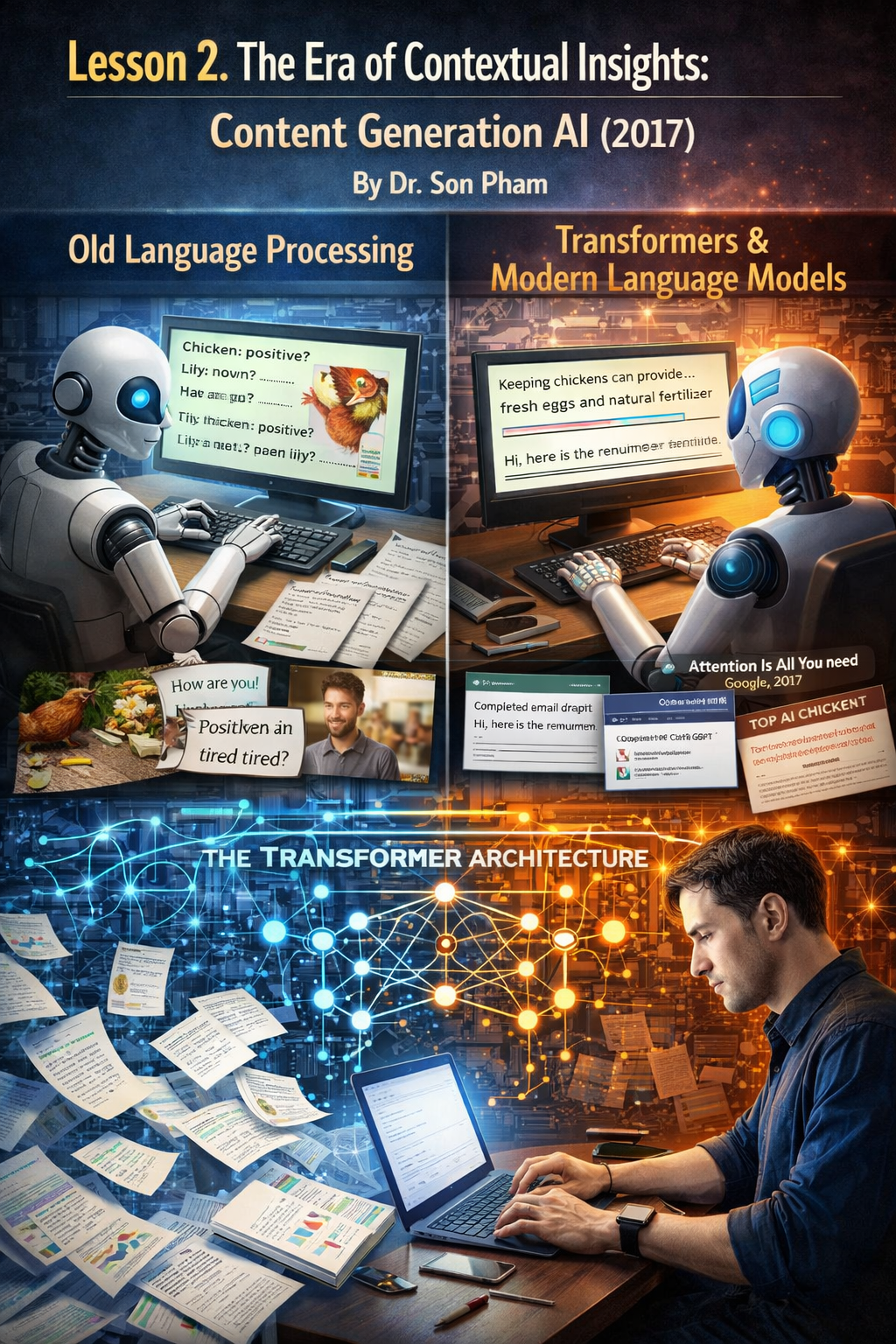

Lesson
2. The Era of Contextual Insights: Content Generation AI (2017)
Dr. Son Pham
If
2012 marked the moment when computers began to "see" the world
through neural networks that recognize images, 2017 marked another important
step forward: computers began to understand and create human language. This is
the basis for the birth of systems that can write text, answer questions,
summarize documents, or even compose poetry and write programming code.
Prior
to this time, computers were able to process text at a basic level. Automated
translation systems and chatbots have been around for years, but their quality
often disappoints users. Computers can translate each word, but they don't
understand the context of the whole sentence. Therefore, the translations are
often mechanical, sometimes corny to the point of laughter. Many people have
experienced strange translations and realized that computers only seem to
understand small parts of the text.
The
turning point occurred in 2017 when researchers at Google published a historic
work called Attention Is All You Need. This paper introduces an entirely new
architecture called Transformer, ushering in the era of modern language models
and laying the foundations for today's artificial intelligence systems.
Weakness
of Short-Term Memory: RNNs and LSTMs
Prior
to the advent of Transformers, the majority of language processing systems were
based on the Recurrent Neural Network architecture. The idea of RNN is quite
intuitive: read text in word-by-word sequence, much like how a human reads a
sentence from left to right. When reading a new word, the model updates its
memory state and then moves on to the next word. Thanks to this mechanism, the
AI can remember part of the information from previously read words.
This
method works quite well for short sentences. However, as the sentence becomes
longer, the system begins to have trouble retaining important information.
During training, the learning signal gradually weakens as it passes through
multiple computational steps, a phenomenon known as vanishing gradient. This
makes it difficult for the model to learn the connections between words that
are far apart in the sentence.
To
overcome this problem, the researchers developed variants such as LSTM or GRU
to help the model remember longer. But no matter how improved, these systems
still have to process documents in a step-by-step sequence. So, when reading to
the end of a very long sentence, the model may have forgotten the subject at
the beginning of the sentence. As a result, AI-generated translations or
paragraphs are often incoherent, like a person trying to remember a long story
but only retaining a few fragments.
The
Rise of the Transformer: The Miracle Named "Attention"
The
Transformer architecture has completely changed the way computers process
language. Instead of reading each word in sequence, the Transformer allows the
model to see the entire sentence at once. This helps the system take advantage
of the power of parallel processing on modern processors and speed up the
learning process many times over.
The
heart of the Transformer is the self-attention mechanism, also known as the
self-attention mechanism. When humans read a sentence, we naturally focus on
the words that are important to understand the meaning of the sentence. For
example, in the sentence "The cat is on the red chair", the words
"cat" and "chair" carry more information than conjunctions.
The self-attention mechanism allows the model to calculate the degree of
association between every pair of words in a sentence, thereby determining
which words need more attention.
Thanks
to this mechanism, AI can understand the complex relationships between words
even though they are located very far apart. For example, in the sentence
"My grandfather held the wooden stick because it was very heavy", the
word "it" can be ambiguous. But when the whole sentence was analyzed,
the system realized that the word "heavy" was closely related to
"stick" and not "grandfather". This ability to understand
the overall context is what makes Transformer such a major breakthrough in
language processing.
From
prediction to content creation
Transformers'
ability to understand context quickly became the foundation for a new
generation of models known as large language models. These systems are trained
on huge volumes of text from the Internet, books, newspapers, and scientific
literature. Through the learning process, they develop the ability to predict
the next word in a sentence with great accuracy.
In
essence, models like GPT act as extremely sophisticated probability prediction
machines. When a user writes a sentence like "Learning is...", the
model analyzes millions of similar examples learned before to calculate which
word is most likely to appear next. After selecting the next word, the process
repeats continuously, gradually forming a complete paragraph.
Interestingly,
as the models become large enough and trained on rich enough data, they begin
to exhibit new capabilities that researchers didn't anticipate. This phenomenon
is called emergence. As a result, AI systems can not only complete simple
tasks, but can also write essays, compose poems, explain scientific concepts,
or write programming code.
Applications
and impacts: changing the way we work
The
development of large language models has led to the creation of artificial
intelligence systems capable of interacting with humans using natural language.
One of the prominent examples is ChatGPT, developed by OpenAI. These systems
can answer questions, write text, summarize documents, and assist with many
other intellectual tasks.
In
the field of programming, AI can analyze the structure of the source code to
find logical errors or suggest improvements. Thanks to the ability to identify
connections between lines of code, the system can help programmers write
software faster and more efficiently. This makes AI a powerful enabler in the
software industry.
In
education and research, AI can summarize hundreds of pages of documents into
easy-to-understand explanations. However, these systems also have an important
weakness: hallucination. Since AI works on probability, it sometimes generates
answers that sound very logical but inaccurate. Therefore, although AI is
becoming more and more powerful, humans still need to play a role in verifying
and directing information.
When
the computer starts to understand the language
If
the turning point of 2012 helped computers see the world through images, 2017
marked the moment when computers began to understand and create human language.
These two advances combined formed the foundation for the modern wave of
artificial intelligence we are witnessing today.
Modern
AI systems not only analyze data, but can also communicate, write content, and
assist humans in a wide range of knowledge areas. From scientific research to
education, from business to art, artificial intelligence is gradually becoming
a new creative tool.
And
it all started with a seemingly simple idea in a 2017 study: for a computer to
understand language, sometimes all it needs is to learn to pay attention in the
right place.