
Lesson
3. When Artificial Intelligence Enters the Physical World: Embodied AI
Dr. Son Pham
If
the 2012 turning point helped the computer see the world through images, and
2017 helped it understand human language, the next phase of artificial
intelligence is even more ambitious: taking that intelligence out of the
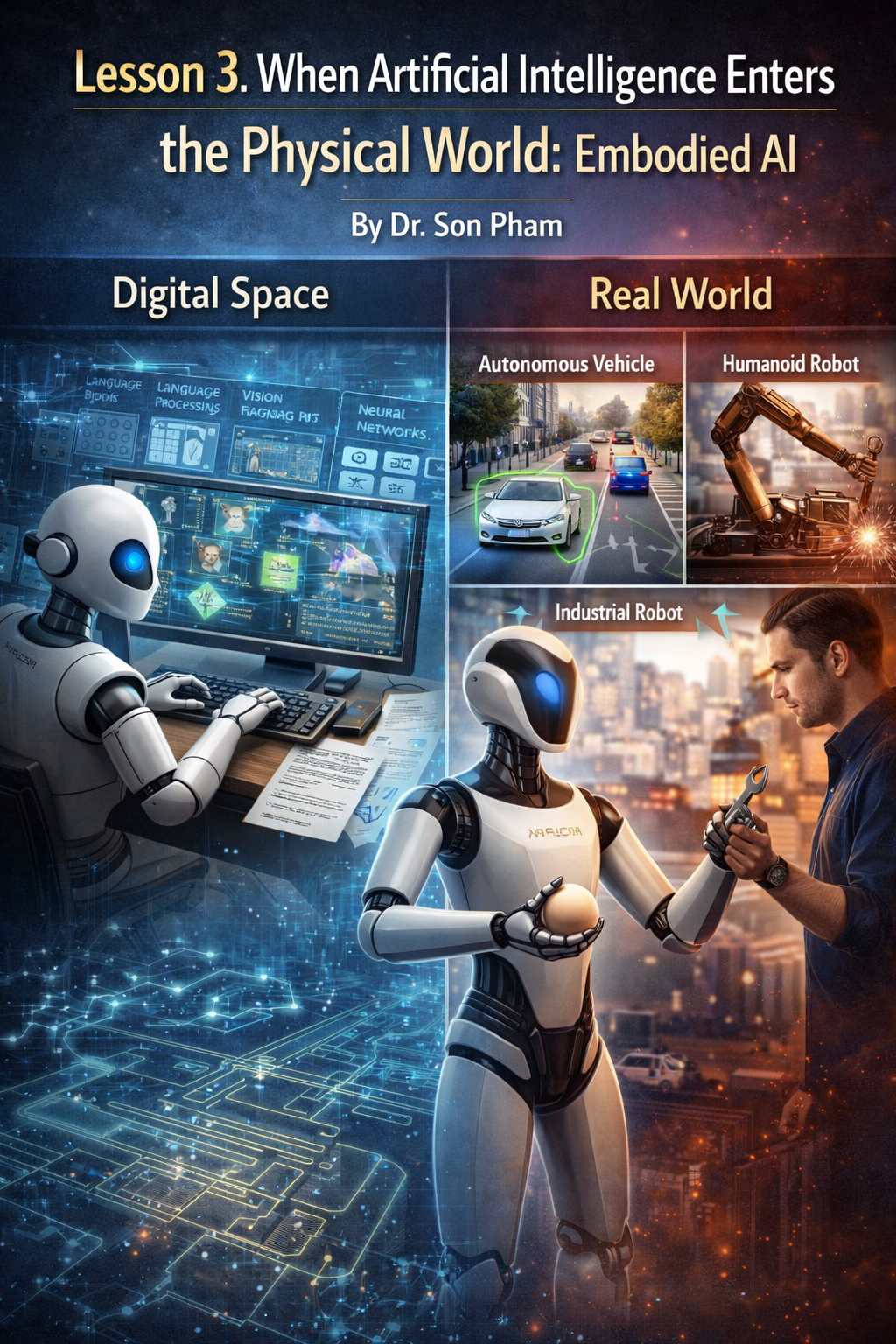
computer screen and putting it in a body that works in the physical world. This
is the field known as Embodied AI, or Embodied AI.
In
previous AI systems, the majority of computer activity took place in the
digital space. A language model can write text, a computer vision system can
recognize images, but it all takes place in a data environment. As AI enters
the physical world, things become much more complicated. At this time,
artificial intelligence needs to understand not only data, but also gravity,
movement, time, and actual risks.
This
transformation is taking place in many fields such as self-driving cars,
industrial robots, and humanoid robots. These systems must not only observe and
analyze, but also make decisions and act. A mistake in the text can be
corrected, but a mistake in the physical world can have serious consequences.
Therefore, Embodied AI is considered the most difficult chapter in the journey
of artificial intelligence development.
Difference
Between Digital Space and Real World
In
the digital space, AI systems operate in a relatively secure environment. If a
language model mispredicts a word or generates a sentence that doesn't make
sense, the user simply deletes it and rewrites it. Mistakes have almost no
physical consequences. This allows researchers to test many new ideas without
worrying too much about risk.
However,
when artificial intelligence enters the real world, every decision can lead to
direct consequences. Imagine a self-driving car driving on the highway. If the
system mistakenly recognizes a sign or brakes at the wrong time, it can be
dangerous for many people. Unlike in a software environment, the physical world
does not have an "undo" button.
In
addition, AI self-determination also has to process data in real time and face
environmental uncertainty. The weather can change, people can act unexpectedly,
and rare situations can always happen. This makes building an AI system that
works safely in the real world one of the biggest technical challenges of our
time.
The
philosophy of "Pure Vision" in autonomous vehicles
In
the field of autonomous vehicles, many technology companies choose to use
sophisticated sensor systems to help vehicles understand their surroundings.
These systems often incorporate various technologies such as cameras, radar,
and laser sensors. Among them, LiDAR is considered one of the most important
tools because it can create very accurate three-dimensional spatial maps.
However,
the Tesla company chose a different direction. Under Elon Musk's leadership,
Tesla pursues a philosophy of "pure vision", that is, building
autonomous vehicle systems that rely mainly on cameras and neural networks.
Their argument is quite simple: the world's transportation system is designed
for humans, and humans drive mostly based on their eyes. So, if it is possible
to build a neural network strong enough to understand images like a human, the
car can also drive safely using only sight.
This
philosophy led to an approach called end-to-end deep learning. Instead of
dividing the system into too many manual processing steps, the image data from
the cameras is fed directly into the neural network. Here, the system learns to
understand the scenery, predict movements, and make driving decisions. This is
a bold approach because it places much of the cognitive responsibility on the
learning capabilities of the neural network.
How
an autonomous car "thinks"
To
understand how autonomous AI works in autonomous vehicles, we can break down
the process into three main steps: awareness, planning, and action. Each step
is supported by neural networks and complex machine learning algorithms.
The
first step is perception. The cameras around the car constantly send images to
the car's central computer. The system uses computer vision models to analyze
each frame and identify important elements such as road surfaces, markings,
other vehicles, pedestrians, and signs. An important technique in this step is
semantic segmentation, which helps the AI distinguish different types of
objects in a scene.
After
understanding the surroundings, the system moves on to the planning step. Here,
the AI calculates various motion scenarios in a very short period of time. For
example, if the car in front of you slows down or a pedestrian is about to
cross the street, the system will quickly evaluate options such as slowing
down, changing lanes, or keeping the same direction. Finally, the action step
sends control commands down to the vehicle's mechanical systems such as the
steering wheel, brakes, and throttle to execute that decision.
Training
with real data and simulations
One
of the biggest challenges of self-determination AI is handling rare situations,
often referred to as edge cases. These situations don't happen often, but
they're important for safety. For example, a car might encounter a person
wearing a strange costume, a bicycle going in the opposite direction, or a
construction site that suddenly appears on the road.
To
solve this problem, Tesla takes advantage of the huge fleet of cars operating
worldwide. Every time a driver has to interfere with the self-driving system,
the data from that situation is sent back to the data center. These examples
become "real-world lessons" that help the model learn how to handle
similar situations in the future.
Besides
real data, companies also use simulated environments to train AI. In these
virtual worlds, the system can experience millions of different scenarios
without risking humans. Generative AI models are also used to create complex
situations such as heavy rain, heavy snow, or chaotic traffic. As a result,
neural networks can "test drive" billions of miles in a simulated
environment before being applied to real life.
From
self-driving cars to humanoid robots
Once
AI systems have learned how to navigate safely in complex environments, the
next step is to extend that ability to other physical tasks. This led to the
development of robots capable of interacting directly with the world around
them. A notable example is the Tesla Optimus humanoid robot.
Unlike
self-driving cars that only need to control the wheels and steering wheel,
humanoid robots have to perform much more sophisticated operations. It needs to
learn to grasp objects, balance when moving, and interact with the environment
just like humans. This requires a combination of computer vision, motion
control, and machine learning.
An
important technique in this process is Reinforcement Learning. In this learning
method, the robot tests a variety of actions and receives a reward for doing it
correctly. Through millions of tests, the system gradually learned how to
adjust grip force, hand angle, and body movement to complete the task. For
example, the robot can learn that holding an egg requires very light force,
while holding a wrench requires more force.
The
future of artificial intelligence
Embodied
AI is considered the next step in the development journey of artificial
intelligence. If language models help AI understand human knowledge, then
embodied systems will allow that intelligence to interact directly with the
physical world. This could open up many applications in manufacturing,
healthcare, logistics, and even in family life.
However,
the road ahead is still challenging. AI systems must achieve a very high level
of safety before they can operate extensively in an environment with humans. In
addition, combining perception, planning, and action in a unified system
remains a complex problem in computer science and robotics.
However,
the development trend is showing a clear direction. Artificial intelligence is
gradually shifting from algorithms that work in computers to entities that can
observe, think, and act in the real world. When that happens, AI will no longer
be just lines of code running on servers, but become a tangible part of the
environment around us.