
Lesson
1. When Machines Decipher Worldview: Artificial Neural Networks (2012)
Dr. Son Pham
Before
2012, the history of information technology used to fall into an interesting
paradox. Computers can perform billions of calculations per second, simulate
the global climate and even pilot space probes, but struggle with a seemingly
simple task: look at a photo and say what it is. A child can instantly
recognize a cat, a car, or a loved one's face, while a computer is embarrassed
by such obvious things.
The
reason is not in computing power, but in the way humans teach machines to
understand the world. For decades, computer systems have been built on a linear
programming model: humans observe phenomena, write down rules, and then ask
machines to apply those rules. This approach is very effective for obvious
logical problems such as calculations or data management, but it proves weak in
the face of the volatile world of images.
The
turning point came when scientists began to shift from the mindset of
"teaching the machine each rule" to "letting the machine learn
from the data on its own". In 2012, the event at the ImageNet Large Scale
Visual Recognition Challenge proved that deep neural networks can go far beyond
any previous method. From that moment, artificial intelligence entered a new
era.
The
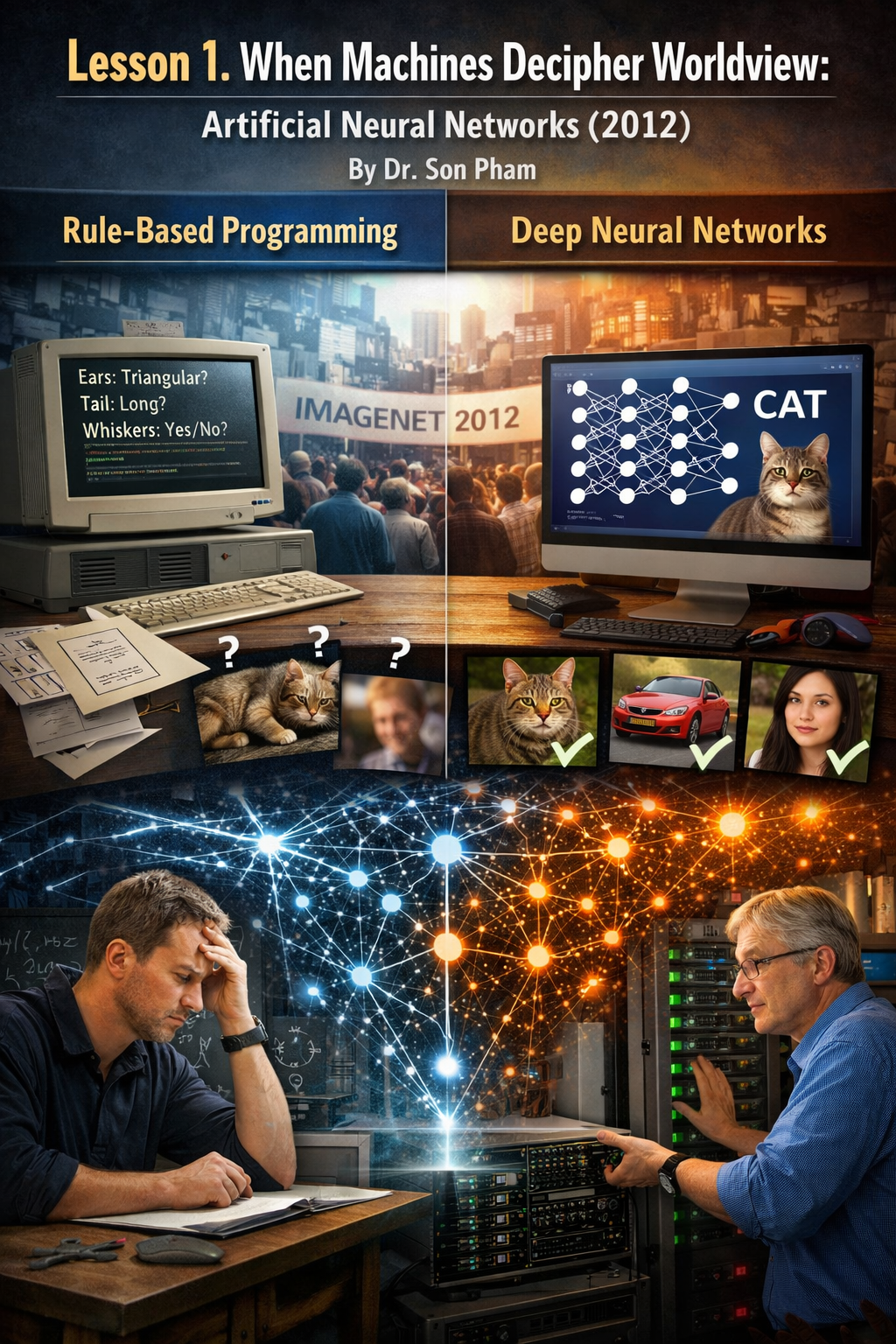
impasse of Rule based Programming thinking
In
the early stages of artificial intelligence, software engineers tried to teach
computers to recognize the world by listing characteristics. For example, if
they want to identify a cat, they will observe and draw typical signs:
triangular ears, beards, and long tails. These characteristics are then
translated into logical conditions in the computer program. When the image
satisfies those conditions, the system concludes that it is a cat.
At
first glance, this approach seems reasonable because it resembles how humans
describe things. However, problems arise when applied to the real world. A cat
may lie curled up so that the tail does not appear in the frame, may turn its
back so that the beard disappears, or be obscured by objects around it. Just a
small detail changes, and the entire rule system can come to the wrong
conclusion.
The
researchers call this phenomenon the infinite variability of the data. In the
real world, no two images are exactly alike. Lighting changes, viewing angles
change, colors change, and every little change can break rigid rules. So
despite the engineers' efforts to add thousands of rules, the system still
can't achieve the flexibility that humans perceive.
AlexNet
2012: Breaking the Limits with Deep Neural Networks
The
turning point came when Geoffrey Hinton's team introduced a system called
AlexNet. Instead of relying on a list of rules written by humans, the system is
built on an artificial neural network. The core idea is to create a structure
of multiple layers of data processing, simulating how neurons in the brain link
together.
In
this model, the image data is included in the form of pixels. Neural networks
don't try to understand the entire image right away. Instead, it analyzes
layer-by-layer. The first layers recognize simple elements such as edges,
lines, or angles. The next layers begin to piece those features together into
more complex shapes such as curves or geometric structures.
As
the data passes through more layers, the neural network gradually recognizes
conceptual features such as eyes, ears, or fur texture. Finally, all the
information is compiled to draw conclusions about the object in the photo. It
is important that these characteristics are not assigned by the programmer but
are discovered by the system itself during the learning process.
Reverse
Propagation Mechanism: The Heart of Evolution
A
neural network can be very complex, but without a learning mechanism it is just
a static mathematical structure. The secret to helping neural networks improve
over time lies in the backpropagation algorithm, also known as backpropagation.
This algorithm allows the system to adjust connections inside the network based
on the error between the prediction and the correct result.
The
learning process begins when the neural network is fed a labeled dataset, such
as millions of images of cats and dogs. The system makes a prediction for each
image, then compares the prediction with the correct answer. If the result is
wrong, a value called the loss function is calculated to measure the degree of
deviation.
This
error signal is then transmitted back through the layers of the network. In the
process, the connection weights between the neurons will be adjusted little by
little. The process is repeated millions of times, causing the neural network
to gradually reduce errors and learn the general patterns of the data. This is
how computers "train" like a learner through experience.
GPU
and Big Data: The two "lungs" that provide power
Although
the idea of neural networks has been around for decades, it wasn't until the
early 2010s that it really took off. One of the important reasons is the
emergence of GPUs, which are graphics processors that are designed to serve the
gaming industry. GPUs are capable of performing thousands of calculations in
parallel, which is very suitable for matrix operations in neural networks.
Thanks
to GPUs, training Deep Learning models becomes feasible in terms of time.
Problems that used to take weeks or months of computation on the CPU can be
reduced to a few days. This improvement opens up the possibility of building
deeper and more complex neural networks.
Parallel
to computing power is the explosion of Internet data. Billions of images shared
online have become a huge source of data for machine learning systems. When
there is enough diverse data, neural networks can learn the true features of
the world instead of just memorizing specific examples. Thanks to the
combination of GPUs and Big Data, Deep Learning has stepped out of the lab and
become the foundation of modern artificial intelligence.
When
computers start "seeing" the world
After
AlexNet's resounding success at the ImageNet Large Scale Visual Recognition
Challenge, the scientific community quickly realized that they were at a major
turning point. For the first time, a computer system can not only process data,
but also learn to extract complex features from images. The error in image
recognition has plummeted, far exceeding all previous computer vision methods.
This
success created a domino effect among artificial intelligence researchers. Labs
around the world are starting to apply deep neural networks to a variety of
problems, from facial recognition to video analysis. Big tech companies are
quick to invest in deep learning, because they realize that the ability to
understand images and sounds will open up countless commercial applications.
In
just a few years, technologies that once existed only in the lab began to
appear in everyday life. Smartphones can recognize faces to unlock, apps can
automatically classify photos, and surveillance systems can detect unusual
behavior. It's all based on the same principle: neural networks learn to
identify patterns from data.
From
computer vision to understanding language and behavior
Once
scientists demonstrate that deep neural networks can understand images, the
next question quickly arises: whether this method can be applied to other forms
of data. The answer is yes. The ideas that developed from Deep Learning quickly
spread to the field of natural language processing, where computers learn to
understand human text and speech.
In
these systems, instead of pixels, the input data is magnetic strings. Neural
networks analyze how words appear together in billions of sentences on the
Internet to learn the structure of a language. Over time, the system begins to
understand more abstract concepts such as context, meaning, and even the
emotional nuances of the sentence.
Thanks
to those advancements, many familiar technologies today become possible. Voice
assistants can understand users' questions, machine translation systems can
switch between multiple languages, and search engines can understand the intent
behind the query. Importantly, all of these capabilities come from the same
foundation: deep learning based on neural networks.
A
philosophical shift in the way artificial intelligence is built
From
the perspective of scientific philosophy, the rise of Deep Learning is not only
a technical advancement but also a change in the way people approach
intelligence. For decades earlier, scientists tried to describe intelligence
using clear logical rules. They believe that if there are enough rules,
computers can simulate human thinking.
But
Deep Learning shows that wisdom can emerge in a different way. Instead of
building knowledge with rigid rules, systems can learn directly from
experience, in the same way that humans learn when observing the world. This
makes artificial intelligence closer to biology, because the learning process
of neural networks has many similarities to the way neural networks in the
brain change as people learn.
This
philosophical shift also explains why ideas that were once seen as overly
simple in the past have become so powerful in the era of big data. When there
is enough data and computing power, machine learning models can discover laws
that are difficult for humans to describe in words.
Widespread
impact in science and industry
After
2012, Deep Learning quickly became one of the fastest-growing fields of study
in computer science. Universities open more training programs in artificial
intelligence, while tech companies pour billions of dollars into research and
applications. From medicine to transportation, from finance to education,
nearly every industry is beginning to explore the possibilities of this
technology.
In
medicine, neural networks are used to analyze X-ray and MRI images to assist
doctors in detecting diseases early. In traffic, computer vision systems help
autonomous vehicles recognize pedestrians and signs. In the field of
e-commerce, deep learning algorithms help analyze user behavior to recommend
suitable products.
It's
worth noting that many of these applications were previously considered too
complex for computers. But as systems learn from millions or billions of
examples, they begin to reach accuracy that equals or even surpasses humans in
certain specific tasks.
Limits
and new questions
While
Deep Learning offers impressive achievements, it also raises many new
questions. One of the biggest challenges is transparency. Deep neural networks
often act as a "black box" where decisions are made based on millions
of parameters that are difficult for humans to explain clearly.
In
addition, machine learning systems rely heavily on data. If the training data
is biased or lacks diversity, the model can learn incorrect conclusions. This
is especially important in sensitive fields such as healthcare, law, or
finance, where algorithm decisions can directly affect humans.
These
challenges have led the scientific community to begin researching new
directions such as artificial intelligence that can be explained, learning less
data, or combining logical knowledge with deep learning. The goal is to build
systems that are not only robust but also reliable.
The
beginning of the modern artificial intelligence era
Looking
back at history, 2012 can be seen as an important transition point in the
development of artificial intelligence. Before that time, many people were
still skeptical about whether computers could truly understand the world. After
the turning point of Deep Learning, the question is no longer "is it
possible", but "how far will it go".
From
image recognition to language understanding, from data analysis to content
creation, neural network-based systems are gradually becoming the foundation of
many modern technologies. These advancements also create the foundation for a
new generation of artificial intelligence capable of interacting with humans in
a more natural way.
So
the story of artificial neural networks is more than just a chapter in the
history of computer science. It marks the moment when machines begin to move
from a state that only executes commands to a state that can learn from the
world. That's when the machine begins to build itself a "worldview"
based on data and experience.